Certified Translation Cost in Canada 2026: A Comprehensive Guide
By WelcomeAide Team

For newcomers to Canada, certified translation is often a required step in the immigration process. Documents from your home country usually need to be translated into English or French by a certified translator before Immigration, Refugees and Citizenship Canada (IRCC) will accept them. The certified translation cost is a real budgeting concern, especially since there is no single published price list. This guide covers why prices vary, what IRCC does and does not say about cost, typical price ranges, what drives the price up, the difference between certified and notarized translation, and how to compare quotes without overpaying.
Why There's No Set Price for Certified Translation in Canada
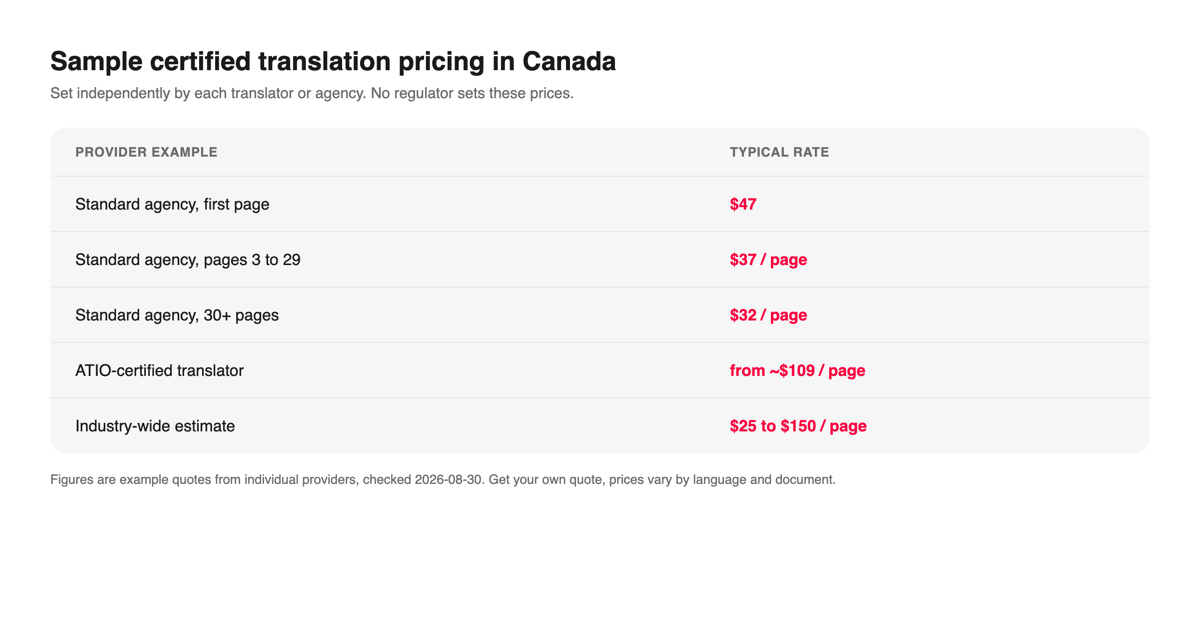
No government body, federal or provincial, and no professional association sets or regulates what a certified translator can charge. Each translator or agency sets its own rates. This means prices will not be uniform across the country, or even within the same city, and comparing quotes is worth the time it takes.
The certification of translators is governed by provincial bodies, even though the price of their work is not. The Society of Translators and Interpreters of British Columbia (STIBC) is one example: as of August 30, 2026, STIBC publishes fees for its own CTTIC certification exam, ranging from $700 to $850 plus tax, but it does not publish a client-facing price list for translation work itself. Ontario's Association of Translators and Interpreters of Ontario (ATIO) and Quebec's OTTIAQ work the same way: they set standards for members, not prices.
What IRCC Actually Requires, and What It Doesn't Say About Cost
IRCC's Express Entry document guidance (verified 2026-08-30) requires that a document not in English or French be accompanied by a translation "stamped by a certified translator," or, if no certified translator is available, by a sworn affidavit from the person who completed the translation. The same rule appears in IRCC's passport program translation page as well. IRCC's wording does not define "certified translator" any further and does not name a specific provincial association as a mandatory requirement, and it does not set, recommend, or reference a price anywhere in either guide. For a full breakdown of which documents this applies to, see our guide to which documents need certified translation.
Typical Certified Translation Cost Ranges
Broad industry estimates put certified translation cost at roughly $0.10 to $0.50 per word, or $25 to $150 per page. For common personal documents like birth certificates, marriage certificates, or diplomas, the average tends to land between $25 and $100 per page.
| Pricing Metric | Typical Range (CAD) | Notes |
|---|---|---|
| Per word | $0.10 to $0.50 | More common for longer or technical documents. |
| Per page, standard documents | $25 to $100 | Birth certificates, diplomas, driver's licences. |
| Per page, complex documents | $100 to $150+ | Medical reports, legal contracts, dense formatting. |
One Canadian agency's published price schedule (checked 2026-08-30) lists a sliding scale: about $47 for a first page, $42 for a second page, $37 per page for pages 3 to 29, and $32 per page for 30 or more pages, plus a small per-stamp fee for items like passport stamps. An Ontario agency's blog post dated 2026-01-04 states that ATIO-certified translation "generally starts around $109 per page." Always confirm whether a quote is per word or per page, and what counts as a "page," before comparing two offers.

What Actually Changes the Price
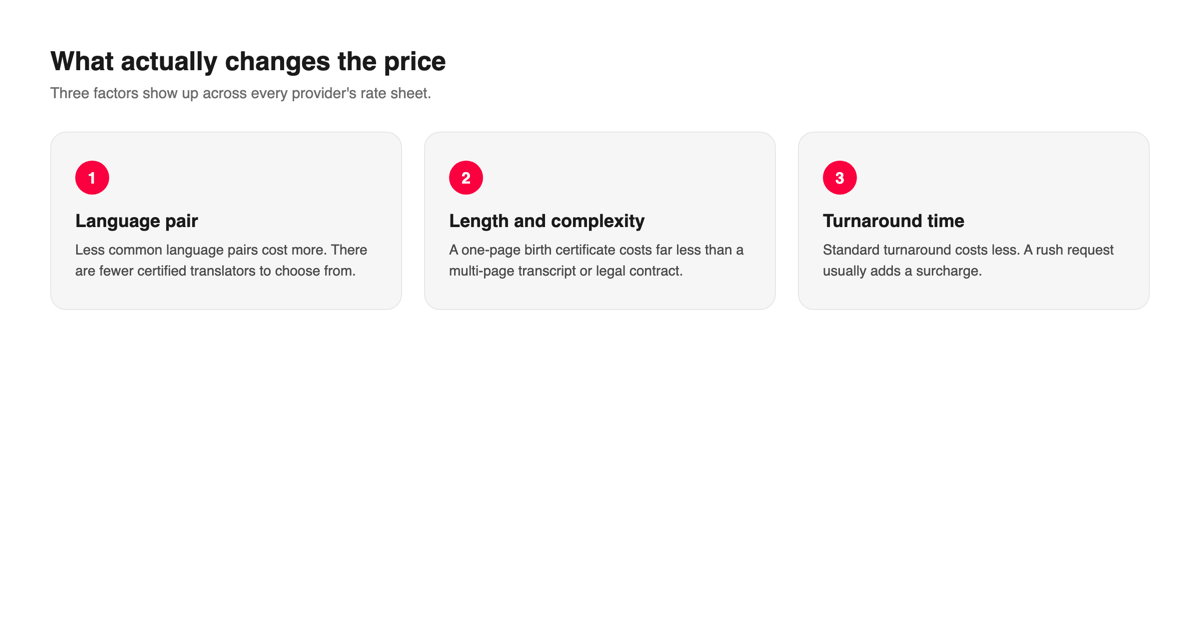
Three factors show up consistently across providers: the language pair, the length and technicality of the document, and the turnaround time. A less common language pair costs more because fewer certified translators handle it. A 50-page transcript costs more than a one-page birth certificate. A rush request, often within 24 to 48 hours, adds a surcharge on top of the standard rate, though the exact amount depends on the translator, so ask for their specific rush rate before committing. If your document is in a less common language, start your search early to avoid paying a rush fee on top of a smaller pool of translators.
Certified vs Notarized Translation: Two Different Costs
A certified translation and a notarized translation are two different services with two different fees. A certified translator's stamp attests to the accuracy of the translation itself. A notary public, when involved, instead attests to the identity of the translator or witnesses their signature on a sworn affidavit, which is a separate step usually billed on top of the translation fee. The added cost for notarization varies by notary and was not independently verified for this guide, so get a specific quote rather than assuming a flat add-on. For a fuller comparison, see our guide to certified vs notarized translation in Canada.
How to Compare Quotes Without Overpaying
Because pricing is unregulated, comparing two or three quotes for the same document is worth the extra step, the same way you would compare quotes for any other professional service.

- Prepare clear scans of every document before contacting a translator, so quotes reflect the real length and complexity.
- Contact a few providers through a provincial directory (STIBC, ATIO, OTTIAQ) or a direct search, rather than accepting the first quote.
- State that the translation is for IRCC, the language pair, and whether you need standard or rush turnaround.
- Ask for an itemized quote: per-page or per-word rate, the certification stamp fee, any notarization fee, and any rush surcharge.
- Compare the full quote, not just the total. A slightly higher price that includes notarization or a faster turnaround you actually need can be the better deal.
A rejected application because of an uncertified or incomplete translation costs far more in time and stress than the difference between two quotes. If you would rather have this handled for you, WelcomeAide's own translation service can prepare a certified translation, or you can start with a free translation quote. For the broader document checklist behind your application, see our settlement checklist or the credential assessment guide if you are translating diplomas or transcripts.
Frequently Asked Questions
Is a certified translation required for all IRCC applications?
If a supporting document is not in English or French, IRCC generally requires a certified translation, or a translation with a sworn affidavit if no certified translator is available. This applies across most application types, including Express Entry, study permits, work permits, and permanent residence.
What is the average cost for a birth certificate translation?
Standard, single-page documents like birth certificates typically run $25 to $100 per page, depending on the language pair, urgency, and provider.
Does notarization cost extra?
Yes, when it applies. Notarization is a separate step from certification and is usually billed separately, ask your notary for a specific quote rather than assuming a flat fee.
Can I translate my own documents for IRCC?
No. IRCC does not accept a translation done by the applicant or an immediate family member. It must come from a certified translator, or from another person accompanied by a sworn affidavit.
How long does a certified translation take?
Many translators offer a standard turnaround of a few business days, with rush service available for an extra fee. Confirm timelines directly with your translator, especially for less common languages.
Navigating certified translation cost can feel overwhelming. The WelcomeAide AI assistant is available 24/7 in your language to answer specific questions and point you to the right resource. Chat with WelcomeAide for free guidance.
Related Resources
Keep WelcomeAide Free
This guide is free, and always will be.
WelcomeAide is a nonprofit. If this helped you, a small donation keeps us running for the next newcomer.
Support WelcomeAideFree Tools for You