Certified translation services in Canada: what counts and how to get one (2026)
By WelcomeAide Team
If any document in your Canadian application is not in English or French, you need a translation, and in most cases it must be a certified translation: one produced by a translator who is a member in good standing of a professional translation body and who stamps the work with their membership seal. Immigration, Refugees and Citizenship Canada (IRCC) states this directly in its Express Entry application instructions, and the same principle runs through passport, citizenship and credential evaluation applications.
This guide explains what a certified translation actually is in Canada, when each major receiver requires one, who is allowed to produce it, what the finished package must contain, and how to order one online without mailing your original documents anywhere. Every rule below was verified against the official source in August 2026, and each official page is linked so you can confirm the current wording yourself.
What a certified translation is
IRCC defines a certified translator as "a member in good standing of a professional translation association in Canada or abroad" whose certification "must be confirmed by a seal or stamp that shows the translator's membership number" (IRCC Express Entry instructions, verified August 2026). Two details in that definition catch people out:
- A translator who is still in the process of receiving certification does not count. The certification must be complete.
- Every stamp or seal on the document that is not in English or French must itself be translated.
Certification belongs to the person, not the company. When you buy a certified translation from any agency, what you are really buying is the stamp and signed attestation of an individual certified translator for your exact language pair.
When you need one
Each receiving institution sets its own rule, and it pays to check the exact requirement before you spend money. As of August 2026:
- IRCC immigration applications (permanent residence, sponsorship, work and study permits): supporting documents not in English or French must come with an English or French translation. IRCC's help centre (updated 2026-04-17) adds that a translation from a non-certified translator needs an affidavit and a certified photocopy of the original.
- Passport applications: the Passport Program accepts translations from certified professional translators and from non-certified professional translators, each with a completed statutory declaration (form PPTC 659). Guides for forms like PPTC 155 repeat the same rule.
- Citizenship applications: Guide 0001 requires translations of every supporting document that is not in English or French.
- Credential evaluation: World Education Services (WES) requires precise word-for-word translations of academic documents; its required documents page lists the rules per country. Our credential assessment guide compares WES, IQAS and ICAS.
- Universities, regulators and courts almost always require certified translations. If you are heading into a regulated profession, our skilled workers guide covers the licensing path.
The three routes IRCC accepts
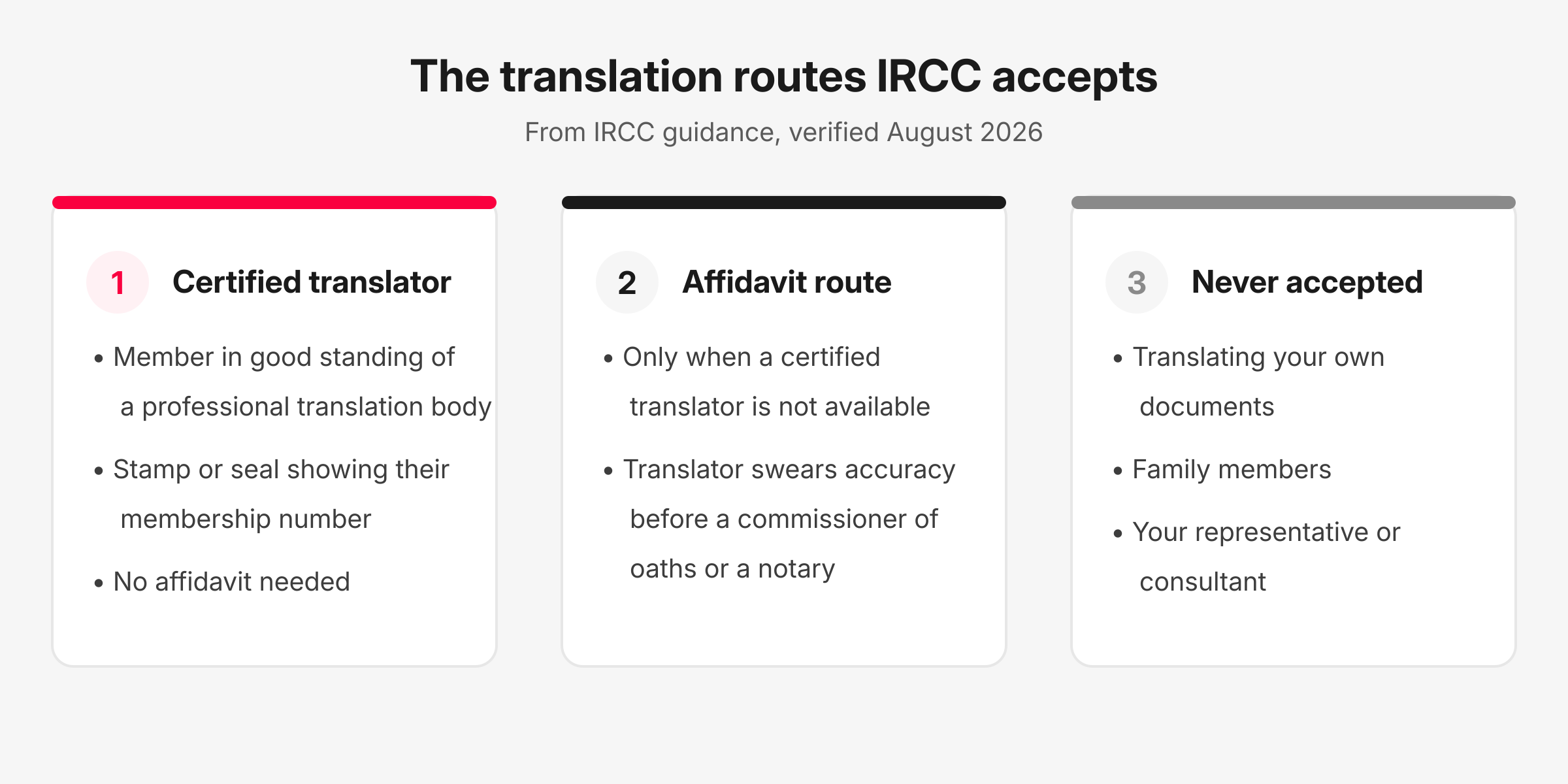
For an IRCC application there are only two valid ways to translate a document, plus a list of people who can never do it:
- Route 1, certified translator: the translator stamps the translation with their seal and membership number. No affidavit is needed. This is the cleanest route and the one IRCC prefers.
- Route 2, affidavit: used only when a certified translator is not available for your language pair. The person who translated swears an affidavit before a commissioner of oaths or a notary, attesting the translation is accurate, and you include a certified photocopy of the original.
- Never accepted: you cannot translate your own documents, and neither can your family members, your representative or your consultant, even if they happen to be a lawyer, notary or translator (IRCC instructions). Applications have been returned over exactly this mistake.
Who certifies translators in Canada
Certification is provincial. Each provincial body admits translators per language pair after examination, and the national federation, the Canadian Translators, Terminologists and Interpreters Council (CTTIC), links them together. The three you will meet most often:
- STIBC, the Society of Translators and Interpreters of British Columbia, with a public directory of certified translators covering more than 40 languages
- ATIO, the Association of Translators and Interpreters of Ontario
- OTTIAQ, the Ordre des traducteurs, terminologues et interprètes agréés du Québec
A translator certified by any of these bodies is accepted by IRCC regardless of which province you live in. What matters is the language pair: a translator certified for Farsi to English cannot certify a Spanish document.
What the finished package contains
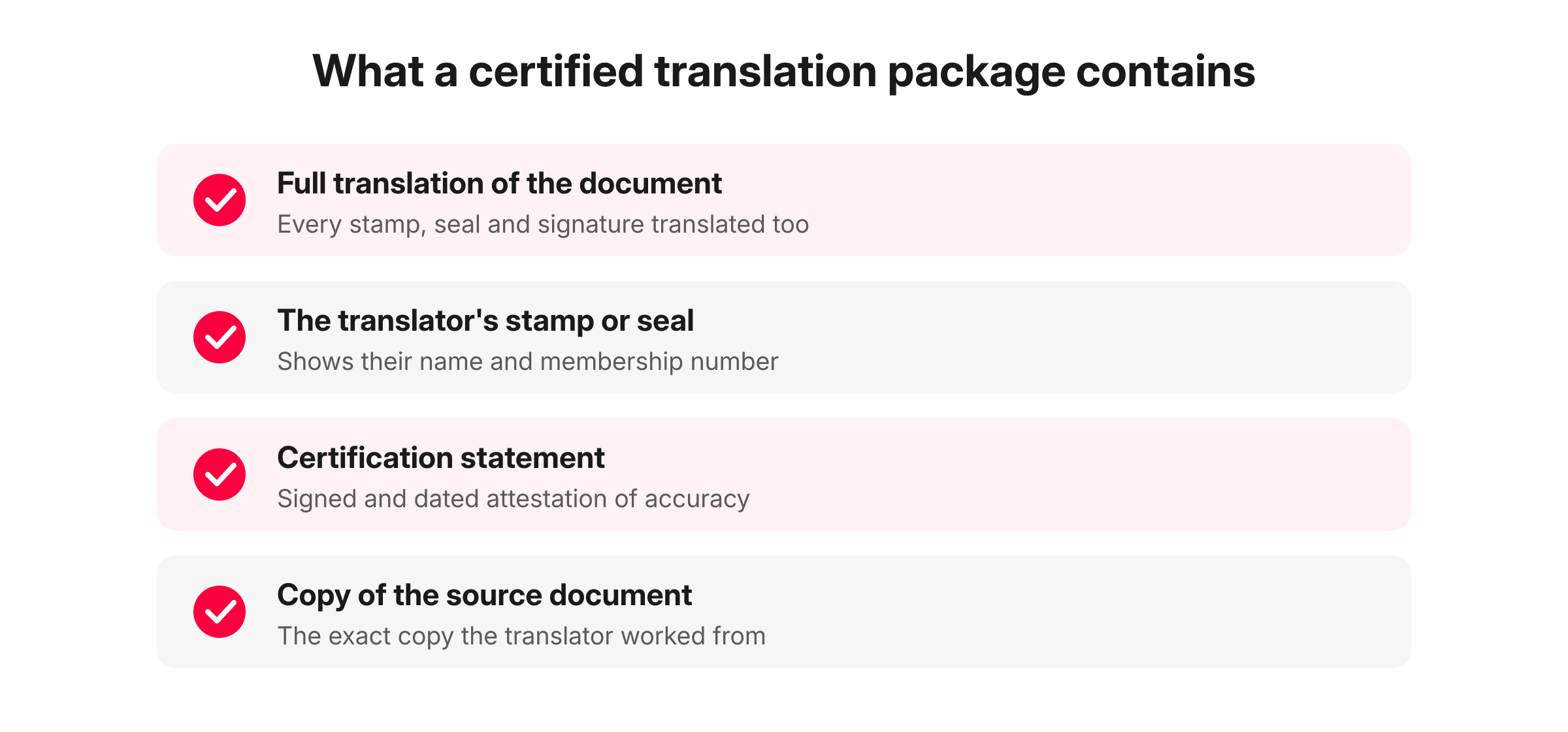
A proper certified translation is a package, not a single page. When it arrives, check that it includes all four parts:
- The complete translation, with every stamp, seal, signature and marginal note translated, not just the main text
- The translator's stamp or seal showing their name and membership number
- A signed and dated certification statement attesting the translation is accurate and complete
- A copy of the source document the translator worked from, usually stamped as well
That package is exactly what you upload to the IRCC portal or include in a paper application. If any part is missing, ask the translator to complete it before you submit.
How ordering works online
You do not need to mail original documents anywhere, and you should be suspicious of any service that asks you to. IRCC applications are submitted as scans, so the standard flow is:
- Photograph or scan your original clearly, in colour, with all four corners visible
- Upload the scan to the translation provider and confirm the language pair and the receiving institution
- The certified translator works from your scan, then produces the stamped package as a PDF
- You upload that PDF straight into your application alongside the scan of your original
Welcome Aide Society, the nonprofit behind this site, runs WelcomeAide Translations, an online certified document translation service built for newcomers: you upload your documents, receive a quote by email within 1 to 2 business days, and get your certified package within 5 business days of payment. Documents are stored encrypted in Canada and deleted after delivery.
How long it takes
Turnaround depends on two things: how quickly a certified translator with your language pair can take the job, and how standardized your document is. Single-page civil documents such as birth or marriage certificates are routine work and typically move in days, while multi-page transcripts, court records and notarial deeds take longer because every stamp and marginal note must be rendered. Whatever service you use, confirm the delivery date in writing before you pay, and build the translation step into your application timeline the same way you plan for a police certificate: order it as soon as you know the document is required rather than when the upload screen asks for it.
Common mistakes that get applications returned
- Having a fluent friend or family member translate. IRCC never accepts this, no matter how qualified they are.
- Translating only the front of a document. Stamps, seals and reverse sides count.
- Submitting a translation without the affidavit when the translator was not certified.
- Ordering the wrong direction, for example an English translation when Quebec requires French.
- Leaving translation to the last week. The IMM 5669 and IMM 0008 stages of a PR application both surface documents people forgot they would need, like a police certificate from a previous country.
FAQ
Does a certified translation expire?
No. The certification attests accuracy, and accuracy does not age. If the underlying document changes, for example a renewed licence, you need the new version translated, but a translation of a birth certificate from years ago remains valid.
Do I need to translate a document that has some English on it?
If any required information on the document is in another language, translate it. Receiving offices will not guess, and IRCC's rule covers documents that are not fully in English or French.
Can a translation done outside Canada be used?
Yes. IRCC accepts certified translators who are members in good standing of a professional association abroad, with the same seal and membership number requirement, and everything not in English or French must be translated, including the seal itself.
Is notarization the same as certification?
No. A notary confirms who swore a statement; a certified translator attests the translation is accurate. IRCC's first choice is the certified translator route, with the notarized affidavit as backup. Our certified vs notarized guide covers the difference in detail.
Related resources
- IRCC: apply for permanent residence through Express Entry
- IRCC help centre: what language should my supporting documents be in?
- Passport Program: translation of documents
- IRCC Guide 0001: citizenship certificate documents
- CTTIC, the national council of translator associations
- STIBC certified translator directory (BC)
- ATIO (Ontario)
- OTTIAQ (Quebec)
- WES Canada: required documents by country
- WelcomeAide Translations: certified document translation
- Settlement checklist
- Government forms assistant
- Language prep guide
- Ask Aida, our multilingual AI navigator
Keep WelcomeAide Free
This guide is free, and always will be.
WelcomeAide is a nonprofit. If this helped you, a small donation keeps us running for the next newcomer.
Support WelcomeAideFree Tools for You