Certified vs notarized translation in Canada: which one you need (2026)
By WelcomeAide Team
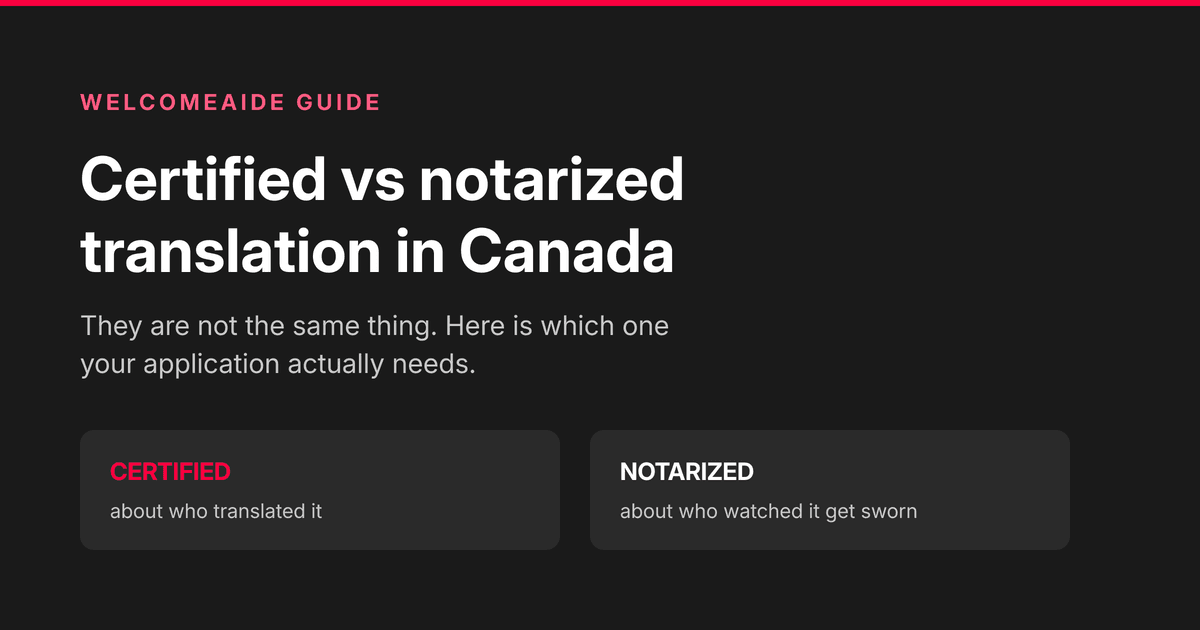
A certified translation and a notarized translation are two different things, and knowing the difference can save you a rejected application and an unnecessary notary fee. A certified translation is produced by a professionally certified translator whose stamp attests the translation is accurate. A notarized translation is an ordinary translation plus an affidavit: the translator swears before a notary or commissioner of oaths that the work is accurate, and the notary confirms who did the swearing.
The confusion matters because Canadian institutions name a specific one. Immigration, Refugees and Citizenship Canada (IRCC) treats the certified translator as the main route and the notarized affidavit as the backup. This guide walks through what each term means, what IRCC, the Passport Program and credential evaluators each accept, and how to decide in under a minute. All rules were verified against the linked official pages in August 2026.
What a certified translation proves
Certification is about the translator. IRCC defines a certified translator as "a member in good standing of a professional translation association in Canada or abroad" whose certification is "confirmed by a seal or stamp that shows the translator's membership number" (IRCC Express Entry instructions). In Canada the certifying bodies are provincial: STIBC in British Columbia, ATIO in Ontario, OTTIAQ in Quebec, and their counterparts elsewhere, connected nationally through CTTIC. The stamp on the translation is the certification: no notary is involved and no affidavit is needed.
What a notarized translation proves
Notarization is about the swearing, not the translating. Anyone can translate the document; they then sign an affidavit in front of a notary public or commissioner of oaths stating the translation is accurate, and the notary stamps the affidavit. The notary is not checking a single word of the translation. They are confirming the identity of the person who swore. That is why IRCC's help centre (updated 2026-04-17) pairs the affidavit route with a certified photocopy of the original document: the affidavit alone carries less weight than a professional certification.
Side by side
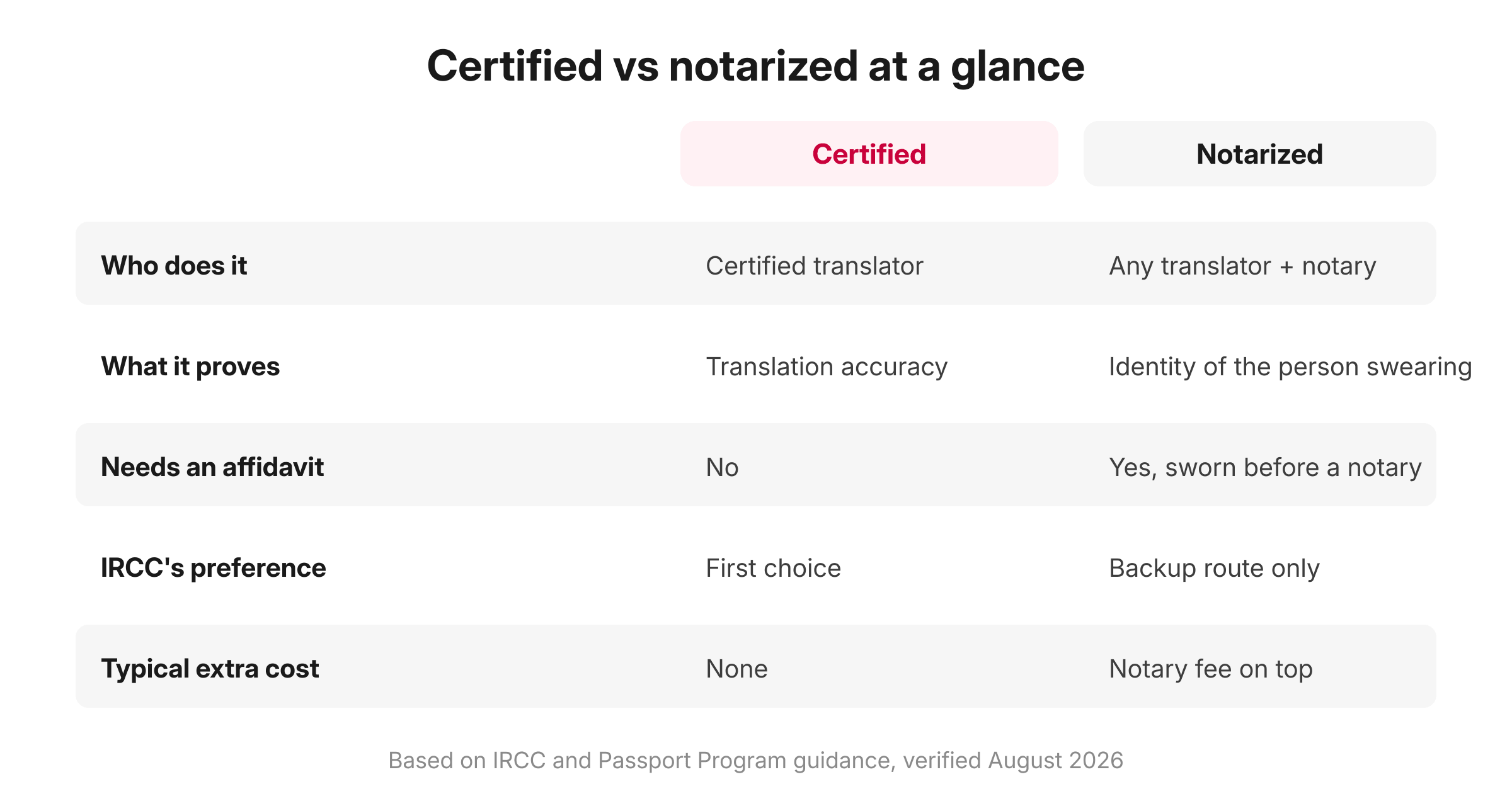
The practical differences come down to five points:
- Who does it: certified requires a certified translator; notarized works with any competent translator plus a notary
- What it proves: certification attests accuracy; notarization attests identity
- Affidavit: not needed for certified; required for notarized
- IRCC's preference: certified first, affidavit route "only if a translation cannot be completed by a certified translator"
- Cost: notarization adds a notary fee on top of the translation itself
What IRCC accepts
For immigration applications, submit either a translation stamped by a certified translator, or a translation accompanied by the translator's affidavit plus a certified photocopy of the original. Translations by you, your family members, or your representative or consultant are never accepted, even if that person is a lawyer, notary or translator, and a translator who is still completing their certification does not count as certified (IRCC instructions, verified August 2026). If you are mid-application, our walkthroughs for IMM 0008 and IMM 5669 show where translated documents get uploaded.
What the Passport Program accepts
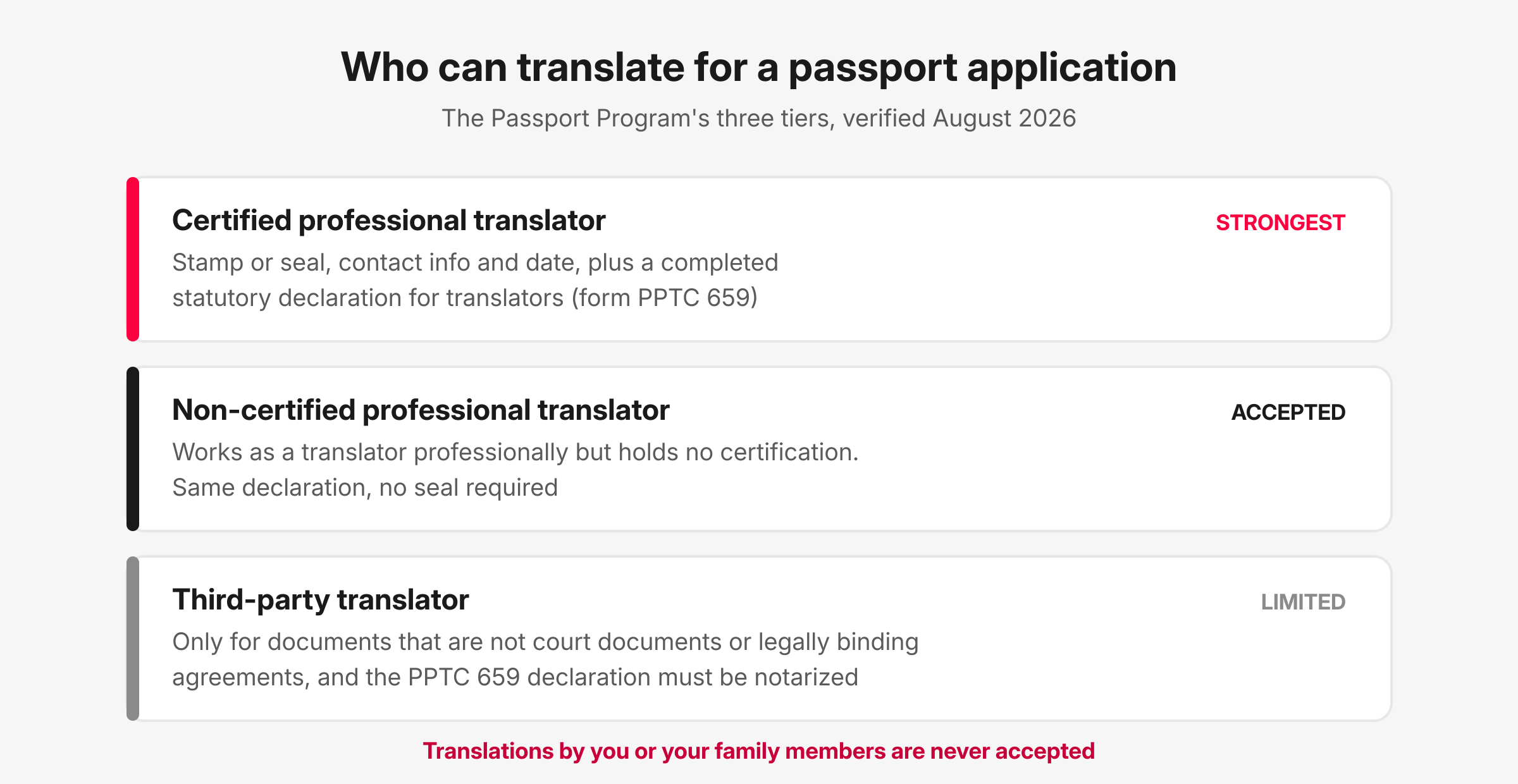
Passport applications follow their own page, translation of documents that accompany a passport application, which sets out three tiers. Certified professional translators provide a stamp or seal, contact information, the date, and a completed statutory declaration for translators (form PPTC 659). Non-certified professional translators provide the same declaration without a seal. Third-party translators are accepted only for documents that are not court documents or legally binding agreements, and their PPTC 659 declaration must be notarized. You must submit both the original document and the translation. Applying for a child? See our PPTC 155 guide.
What citizenship and credential evaluators accept
Citizenship applications under Guide 0001 require translations of all documents that are not in English or French, following the same certified-or-affidavit logic as other IRCC streams. World Education Services (WES) asks for precise word-for-word translations of academic documents and lists per-country requirements on its required documents page; our credential assessment comparison explains where translations fit in that process. Courts and professional regulators almost always insist on certified translators, which also matters for licensing in regulated professions.
How to decide in under a minute
- Sending documents to IRCC, a court, a regulator, WES or a university? Order a certified translation. It is accepted everywhere, needs no notary, and fails nowhere.
- No certified translator exists for your language pair? Use the affidavit route: a professional translator swears accuracy before a notary, and you attach a certified photocopy of the original.
- Someone tells you to "get it notarized" without saying why? Ask the receiving office what it requires in writing. Paying for notarization on top of certification is usually paying twice for no benefit.
If you are unsure which documents in your application even need translation, run through our settlement checklist or ask Aida, which answers in 21 languages. For the translation itself, WelcomeAide Translations provides certified document translation online: upload your documents and a quote arrives by email within 1 to 2 business days, with delivery within 5 business days of payment.
The documents newcomers translate most often
The same short list of civil documents accounts for most translation orders, whichever route you choose: birth certificates, marriage and divorce certificates, police clearance certificates, academic diplomas and transcripts, driver's licences, and bank or employment letters used as proof of funds or work history. Two patterns are worth knowing. First, civil registry documents are short and highly standardized, so turnaround is fast once a translator with your language pair takes the job. Second, multi-page documents like transcripts and court records are where the affidavit route gets expensive, because the notary step adds a fee while the certified route stays a single service. If your application also needs a police certificate from a country you lived in earlier, request it early: obtaining the original usually takes far longer than translating it.
Common mistakes
- Paying a notary to stamp a translation done by a certified translator. The certification already does the job.
- Assuming a notarized translation satisfies a receiver that asked for a certified one. It may not, and IRCC treats the affidavit route as the exception.
- Letting a family member translate and then notarizing it. The notary stamp does not cure the family member problem; IRCC still refuses it.
- Forgetting that stamps and seals on the original must be translated too, whichever route you take.
- Missing the PPTC 659 declaration on passport applications, which is required in all three translator tiers.
FAQ
Is a notarized translation cheaper than a certified one?
Usually it is more expensive, not less. You pay the translator and then the notary on top. The certified route has one professional and one fee, which is part of why IRCC prefers it and why we recommend starting there.
Can a notary public translate my document?
Only if the notary is also a professional translator, and even then IRCC bars anyone who is your representative from translating your documents. A notary's commission is about witnessing oaths, not language skill.
Who can certify a translation in British Columbia?
A translator certified by the Society of Translators and Interpreters of British Columbia (STIBC) for your exact language pair. Certification from another provincial body such as ATIO or OTTIAQ is equally valid for IRCC purposes.
Do other countries' certified translators count for IRCC?
Yes. IRCC accepts members in good standing of professional translation associations abroad, as long as the seal or stamp shows the membership number and any non-English, non-French seal text is itself translated.
Related resources
- IRCC: apply for permanent residence through Express Entry
- IRCC help centre: what language should my supporting documents be in?
- Passport Program: translation of documents
- IRCC Guide 0001: citizenship certificate documents
- STIBC (British Columbia)
- ATIO (Ontario)
- OTTIAQ (Quebec)
- CTTIC national council
- WES Canada: required documents
- Certified translation services in Canada: the full guide
- WelcomeAide Translations
- Government forms assistant
- WelcomeAide FAQ
Keep WelcomeAide Free
This guide is free, and always will be.
WelcomeAide is a nonprofit. If this helped you, a small donation keeps us running for the next newcomer.
Support WelcomeAideFree Tools for You