Certified Translation IRCC: Your 2026 Guide to Required Documents
By WelcomeAide Team

Applying for Canadian immigration, whether for permanent residence, a work permit, or a visitor visa, means submitting documents to Immigration, Refugees and Citizenship Canada (IRCC) exactly as it requires them. If a document is not already in English or French, it needs to be translated in a specific way, and getting this wrong is a common reason applications come back incomplete. This guide covers IRCC's exact wording, the two accepted ways to submit a translation, which documents usually trigger the rule, and what counts as a certified translator.
IRCC's Translation Rule, in Its Own Words
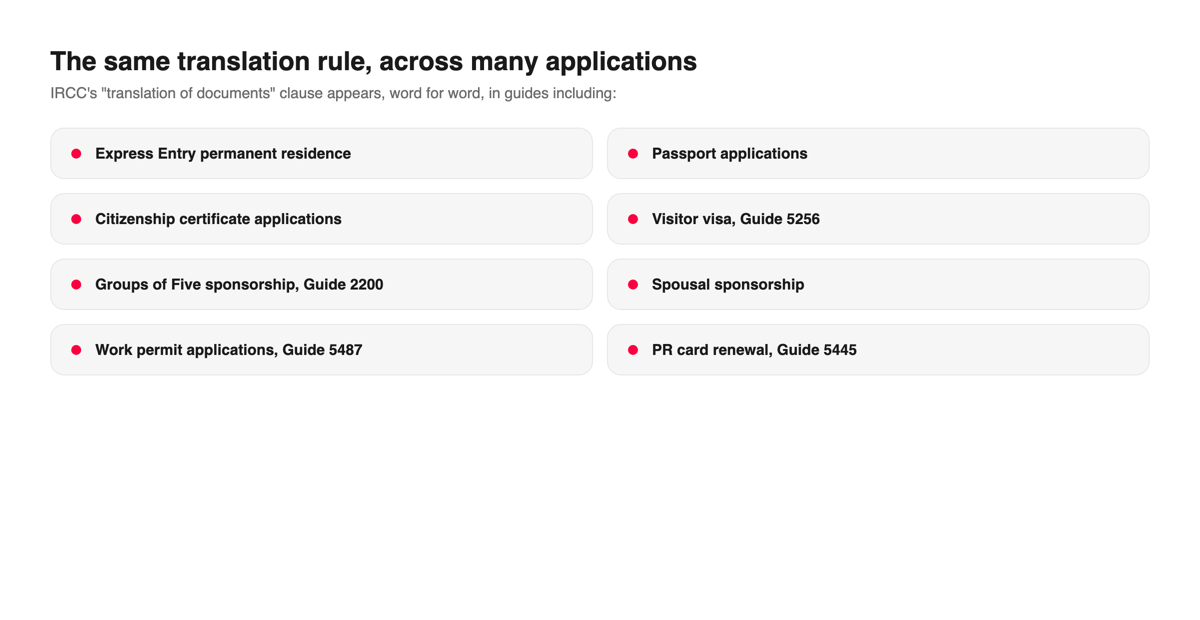
IRCC's exact wording, verified live on August 30, 2026, from the Express Entry permanent residence document guide, states that if a document is in a language other than English or French, applicants must also upload an English or French translation that is "stamped by a certified translator," with any foreign-language stamps or seals on the original also translated, and a scan of the original document. The identical clause appears in IRCC's passport program translation page and in the citizenship certificate application guide, and, per Google search results confirming the same wording, in guides for visitor visas (Guide 5256), Groups of Five refugee sponsorship (Guide 2200), spousal sponsorship, work permits (Guide 5487), and PR card renewal (Guide 5445). IRCC's help centre also addresses this directly in its translation of documents FAQ. This is IRCC's standard, program-agnostic rule, not something specific to one application type, so always check your own program's document checklist for the details, but expect this core requirement either way.
Two Accepted Paths
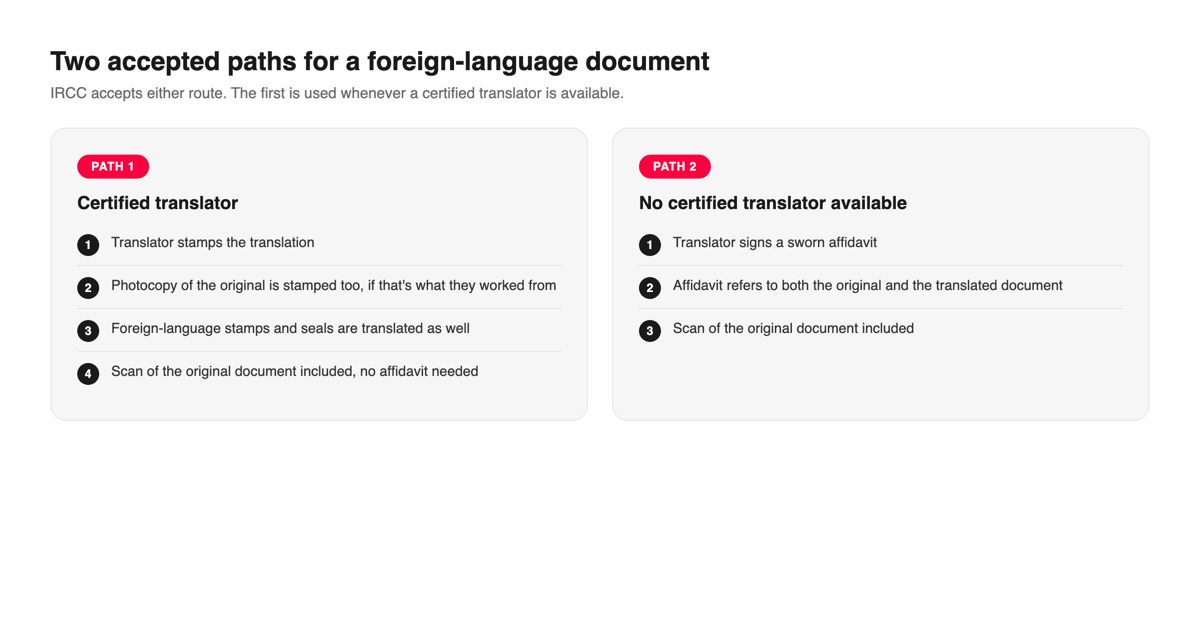
Path 1, a certified translator: the translator stamps the translation, stamps the photocopy of the original if that is what they worked from, and translates any foreign-language stamps or seals too. Applicants may include a scanned letter explaining that no affidavit is needed because a certified translator was used.
Path 2, no certified translator available: the translation is instead accompanied by a sworn affidavit from the person who completed it, and the affidavit must refer to both the original and the translated document. IRCC's own wording does not name a specific provincial association, such as STIBC in BC, ATIO in Ontario, or OTTIAQ in Quebec, as a mandatory requirement for Path 1, it only requires that the translator be certified and apply a stamp. Choosing a translator listed in a provincial directory is still a reasonable precaution, not an IRCC-stated rule.
Either path also requires a scan of the original document, or a scan of a certified photocopy of the original that the translator worked from, alongside the translation itself.

Common Document Types That Need Translation
IRCC does not publish one master list for every program, each application type has its own document checklist. Document types that commonly trigger this rule fall into a few groups.

Civil status documents: birth certificates, marriage certificates, divorce certificates and legal separation agreements, and death or adoption certificates where relevant, drawn from IRCC's own marital-status document checklist. These establish identity, lineage, and current marital status, and are among the most frequently translated documents across almost every application type.
Educational documents: academic transcripts and diplomas, often tied to an Educational Credential Assessment (ECA) for Express Entry or a provincial nominee program. The ECA process may have its own translation steps, but the underlying IRCC translation-of-documents rule still applies to whatever you submit with the final application.
Police and identity documents: police certificates are required for most permanent residence applications from every country lived in for six months or more since age 18, see our guide to police checks and background screening for the full process. Passport pages are usually already in English or French, but a stamp or annotation in another language may still need translation if it carries information relevant to your application.
Always confirm the exact list against your own program's checklist rather than assuming one universal list applies, IRCC's requirements differ by program even though the translation rule itself does not.
What Counts as a Certified Translator, and What IRCC Does Not Require
IRCC's published wording does not define "certified translator" beyond requiring the stamp itself, and it does not name a specific membership requirement. In practice, provincial associations like STIBC, ATIO, and OTTIAQ maintain public directories of certified members, which is a reasonable way to verify a translator's standing even though it is not an IRCC-mandated step. What IRCC does not require: membership in one specific Canadian association, and a detailed definition of "certified" beyond the stamp requirement.
Mistakes Worth Double-Checking Before You Submit
IRCC's own text does not list specific rejection reasons tied to this section, but the elements its own wording asks for are exactly what tends to go missing. Before you submit, check for these:
- Missing translator's stamp. The translation is uploaded but the certified translator's stamp is not visible, or is missing from the photocopy the translator actually worked from.
- Missing scan of the original. Only the translated document is uploaded, with no scan of the original in its native language for IRCC to check the translation against.
- Incomplete affidavit. If you used Path 2, the affidavit does not clearly refer to both the original and translated document, or was not properly sworn.
- Untranslated stamps or seals. The body text is translated, but a stamp, seal, or handwritten note on the original was skipped. These can carry dates or issuing-authority details IRCC needs.
- Using the affidavit path when a certified translator was available. This is allowed, but a certified translator's stamp is the simpler route when one is accessible for your language pair.
A missing element here is a common reason an application comes back as incomplete or triggers a request for more information, so it is worth a second look before you submit, ideally against your own program's document checklist rather than a general list like this one.
If you would rather have a certified translation handled for you, WelcomeAide's own translation service covers the documents above, or start with a free translation quote. For real sample pricing, see our guide to certified translation cost in Canada, and for the difference between the two related terms, see certified vs notarized translation. For the rest of your document checklist, see our settlement checklist.
Frequently Asked Questions
What happens if I don't provide a certified translation?
An application missing a required translation may be deemed incomplete, returned, or refused, which can significantly delay your process and may require resubmission.
Can I translate my own documents for IRCC?
No. IRCC does not accept a translation done by the applicant or an immediate family member. It must come from a certified translator, or from another person accompanied by a sworn affidavit.
Do I need to translate every stamp in my passport?
Generally, only stamps or annotations that carry information relevant to your application need translation. If in doubt, have them translated by a certified professional rather than guessing.
How much does a certified translation cost?
Pricing is not regulated and varies by translator, language pair, and document length. See our full certified translation cost guide for real sample pricing.
Where can I find a certified translator?
Provincial directories such as STIBC, ATIO, and OTTIAQ list certified members. WelcomeAide's own translation service is another option.
Navigating certified translation requirements can feel overwhelming. The WelcomeAide AI assistant is available 24/7 in your language to answer specific questions and point you to the right resource. Chat with WelcomeAide for free guidance.
Related Resources
Keep WelcomeAide Free
This guide is free, and always will be.
WelcomeAide is a nonprofit. If this helped you, a small donation keeps us running for the next newcomer.
Support WelcomeAideFree Tools for You